
Core belters
Core belters are core shooting machines with automatic belt discharge for series production of cores.
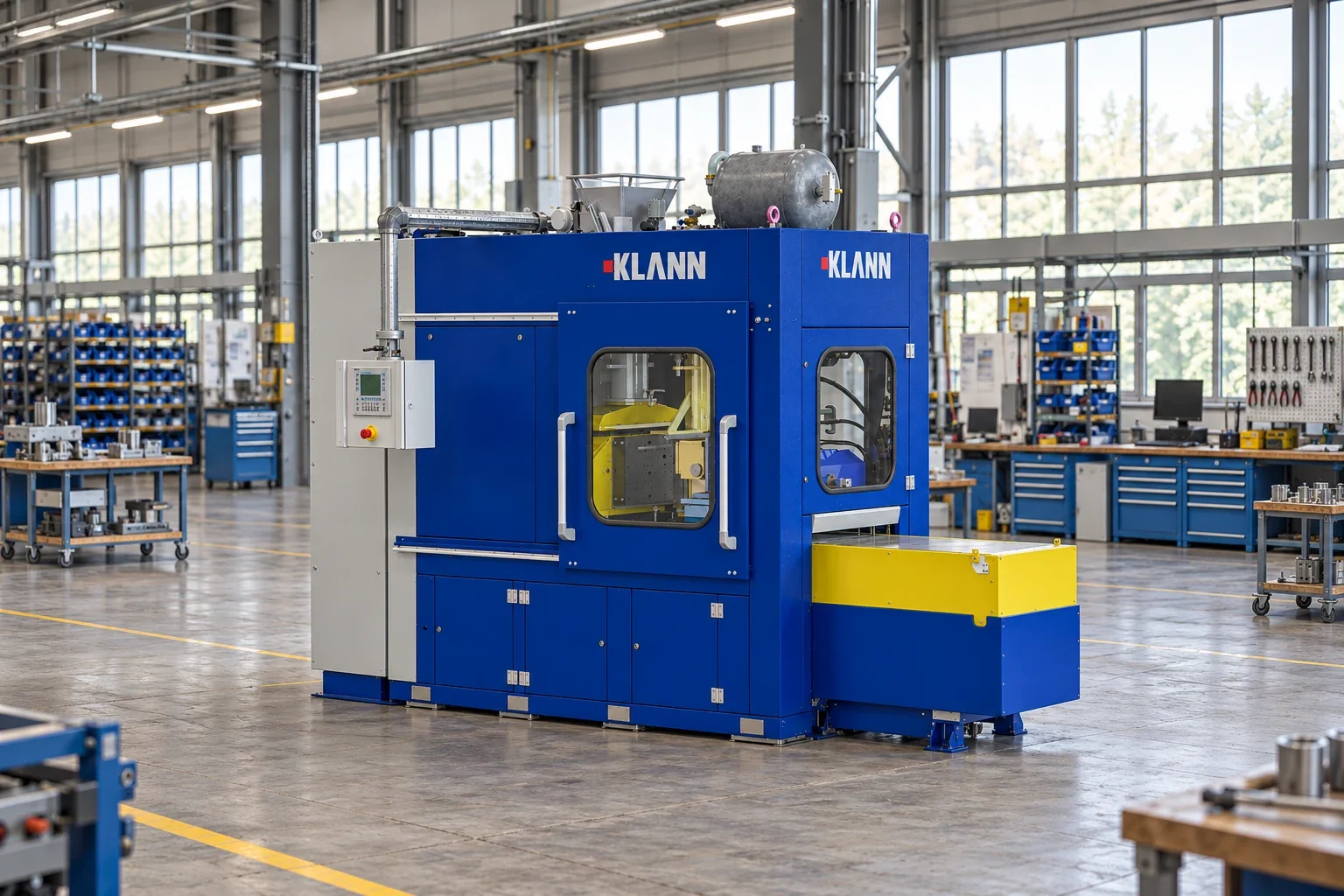
Technical overview
- Core discharge
- Automatically via a conveyor belt
- Application
- Series production, including automotive and valve industries
- Hot-Box models in the table
- P5, P8 and P15 BA/HB
- Shooting volumes listed in the table
- 5, 8 and 15 dm³
Technical details
Core belters are core shooting machines with automatic belt discharge for series core production.
They are primarily used for series production of cores in the automotive and valve industries.
KLANN core belters offer:
- Short travel distances produce machine cycle times starting at 5 seconds, excluding additional process-dependent times
- Fully automatic operation without operator release
- Placement, discharge and buffering of the produced cores on a conveyor belt, without a continuous need for personnel
- High core box clamping forces and precise guidance minimise flash and subsequent finishing of the cores
- Gentle discharge and placement of the cores on the height-adjustable conveyor belt
- Full enclosure with wide access doors for waste heat and exhaust air extraction and protection against sand ejection
- Easy core box change with optionally installed lifting equipment
- Hydraulic control with proportional valves reduces core breakage by opening core boxes gently
- Variable filling volumes in the shooting cylinder prevent repeated agitation and premature curing of the core sand
- Compact design with a small footprint
Optional equipment for KLANN core belters:
- Core box changing device
- Core pin pulling device
- Lateral loose-piece pulling device
- Automatic tilting cradle adjustment
- Adaptation to different core box widths
- Automatic deburring device
- Base frame with cleaning drawers
- Core handling robots for further processing or storage
Technical data
On small screens, you can scroll the table horizontally.
| Feature | Unit | P5- BA/HB | P8- BA/HB | P15- BA/HB |
|---|---|---|---|---|
| Shooting volume | dm³ | 5 | 8 | 15 |
| Sand storage — feeding | dm³ | 60 | 60 | 120 |
| Adjustable shooting pressure | bar | 1 - 6 | 1 - 6 | 1 - 6 |
| Compressed air consumption per cycle | dm³ | 25 | 32 | 50 |
| Cycle times excluding heating, pin pulling and blowing | sec. | 5 | 7 | 10 |
| Core box dimensions | ||||
| Min. width per half | mm | 40 | 40 | 40 |
| Max. width per half | mm | 110 | 110 | 110 |
| max. Length | mm | 500 | 600 | 800 |
| max. Height | mm | 250 | 300 | 500 |
| Clamping device stroke | mm | 320 | 320 | 400 |
| Discharge belt width | mm | 500 | 600 | 800 |
Questions and answers
How does a core belter differ from machine table discharge?
The core belter places the produced cores on a conveyor belt. While the next core is being made, the belt discharges and buffers the previous core. Separate core removal at the machine table is not required.
Does a 5-second cycle time mean a finished core every 5 seconds?
Not in every case. The table specifies a machine cycle time of 5 seconds for the P5 BA/HB, excluding heating, pin pulling and blowing. The P8 and P15 are listed at 7 and 10 seconds respectively. The complete cycle time depends on the process.
What functions does the discharge belt perform?
The belt handles placement, discharge and buffering. During transport through the core belter, the cores can continue to cure and release gases before further handling.
Do rejected cores need to be removed separately?
Not necessarily. Cores that are not picked up can fall into a reject container at the end of the belt. This avoids an additional removal operation.
Which optional equipment is available?
Options include core box changing aids, pin and loose-piece pulling devices, automatic tilting cradle adjustment, deburring and core handling robots.